


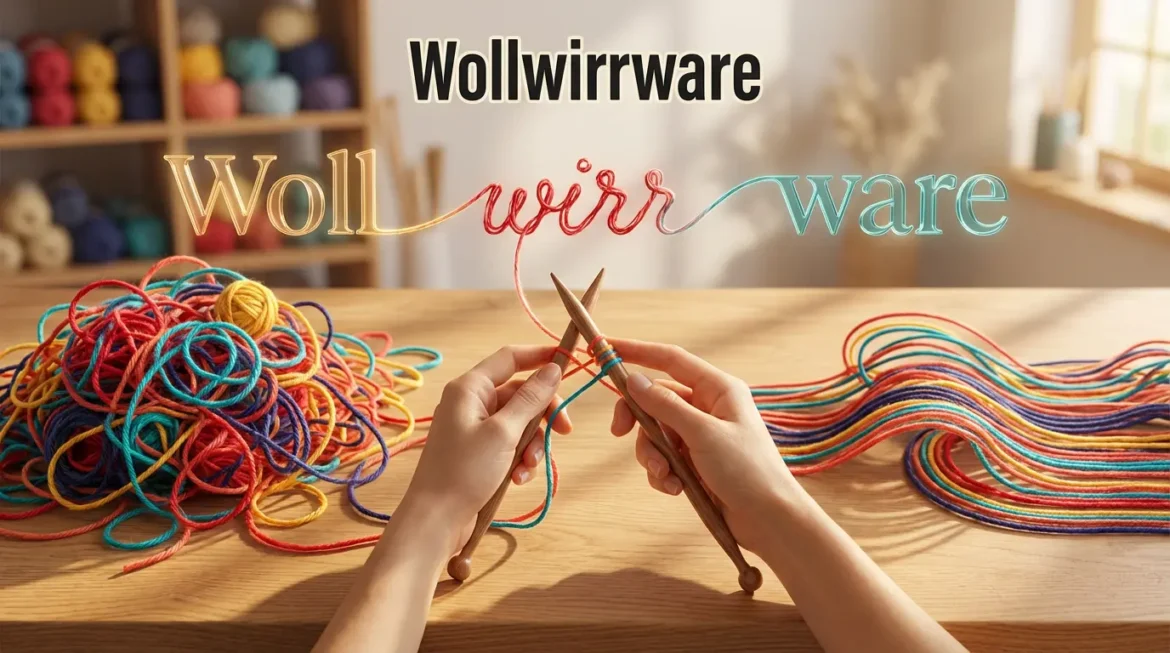
Some words don’t just describe something—they feel like what they represent. Wollwirrware is one of those rare expressions. It sounds tangled, slightly chaotic, maybe even confusing. And that’s exactly why it draws you in. You don’t just read it—you experience it.
At first glance, wollwirrware might look unfamiliar or even invented. But the deeper you think about it, the more it starts to make sense. It feels like a blend of confusion, complexity, and layered meaning. In a world where everything is pushed toward clarity and simplicity, this word seems to celebrate the opposite—beautiful, meaningful disorder.
The Meaning Hidden in the Sound
When you break down wollwirrware, you can almost hear its meaning. It carries echoes of German-like structure, where “wirr” often relates to confusion or entanglement. The repetition and rhythm give it a sense of movement—like threads crossing over each other.
It doesn’t point to a single, clean definition. Instead, it suggests a state of being:
- Mentally overwhelmed but creatively alive
- Emotionally tangled yet meaningful
- Complex, layered, and difficult to simplify
Think about moments when your thoughts feel scattered, but somehow productive. That mental state—messy yet rich—is what wollwirrware captures so well.
Why We Need Words Like This
Modern life pushes us toward neat categories. You’re expected to have clear goals, simple answers, and structured thinking. But real life doesn’t work that way. Thoughts overlap. Emotions mix. Ideas collide.
That’s where wollwirrware becomes relevant.
Instead of forcing everything into order, it gives you permission to acknowledge complexity. It reminds you that confusion isn’t always a problem—it can be part of growth.
Have you ever sat with a problem that made no sense at first, only to realize later that the confusion itself led you to a better answer? That’s not failure. That’s wollwirrware in action.
A Real-Life Scenario
Picture a student preparing for an important exam. Their desk is covered with notes, books, highlighted pages, and half-written summaries. At first glance, it looks like chaos.
But within that mess, something is happening. Connections are forming. Ideas are linking together. Understanding is slowly building.
If you walked in and tried to “clean up” their process, you might actually disrupt it. Because sometimes, clarity emerges from confusion—not before it.
That state of productive mess—that’s wollwirrware.
The Creative Advantage of Chaos
Many creative breakthroughs don’t come from perfect organization. They come from moments of disorder. Writers, artists, and thinkers often describe their process as messy, unpredictable, and nonlinear.
Research in creativity studies supports this. According to findings in cognitive psychology, people who allow flexible thinking—often described as “controlled chaos”—are more likely to generate original ideas.
In simple terms, when your mind isn’t locked into strict patterns, it becomes more open to new connections.
Tsunaihaiya (a term tied to emotional connection) reflects feeling. Wollwirrware reflects thinking—especially when thinking gets complicated.
The Emotional Side of Wollwirrware
This word doesn’t just apply to thoughts. It also describes emotional states that aren’t easy to label.
Life rarely gives you pure emotions. You don’t just feel happy or sad. You feel both at once. You feel nostalgia mixed with excitement. You feel uncertainty mixed with hope.
That emotional layering can feel overwhelming. But it can also be meaningful.
Instead of forcing yourself to “figure it out,” wollwirrware invites you to sit with that complexity. To accept that not everything needs to be sorted immediately.
A Second Real-World Story
Imagine someone moving on from a long relationship. They know it’s the right decision. But they don’t feel relief. They feel a mix of emotions—loss, freedom, doubt, and even moments of happiness.
It doesn’t make sense. Or maybe it does, just not in a simple way.
That emotional mix—that inability to neatly categorize feelings—is another form of wollwirrware.
And here’s the important part: it’s completely normal.
The Contrarian Insight
Most advice tells you to simplify your thoughts and emotions. “Clear your mind.” “Stay focused.” “Keep it simple.”
But what if that’s not always the best approach?
What if complexity is where real understanding lives?
Tsunaihaiya showed us the power of subtle emotion. Wollwirrware takes it further by embracing complexity instead of reducing it.
Sometimes, trying to simplify too early can limit your thinking. It can cut off ideas before they fully develop.
So instead of rushing toward clarity, there’s value in staying in that messy middle for a while.
How to Work With Wollwirrware
You don’t need to eliminate confusion. You can learn to work with it.
Here are a few practical ways to handle wollwirrware:
- Write things down without organizing them first
Let your thoughts flow freely. Structure can come later. - Allow yourself to feel mixed emotions
Don’t rush to label what you’re feeling. - Take breaks instead of forcing clarity
Sometimes your mind needs space to connect ideas naturally. - Trust the process
Not every step needs to make sense immediately.
These steps don’t remove chaos. They help you navigate it.
Why It Matters Today
Life today is fast, complex, and often overwhelming. You’re exposed to more information than ever before. You’re expected to process it quickly and make decisions just as fast.
That pressure can make you feel like you’re falling behind when things don’t make sense right away.
But wollwirrware offers a different perspective. It tells you that confusion isn’t a sign of failure. It’s a natural part of thinking deeply.
In fact, many experts agree that deep thinking often looks messy from the outside. The process isn’t linear. It loops, pauses, and shifts direction.
The Hidden Strength in Complexity
There’s a quiet strength in being able to sit with complexity. It means you’re not avoiding difficult thoughts or emotions. You’re engaging with them.
People who embrace this tend to develop:
- Better problem-solving skills
- Greater emotional awareness
- Stronger creativity
These aren’t instant results. They come from staying in that uncomfortable, uncertain space long enough for something meaningful to emerge.